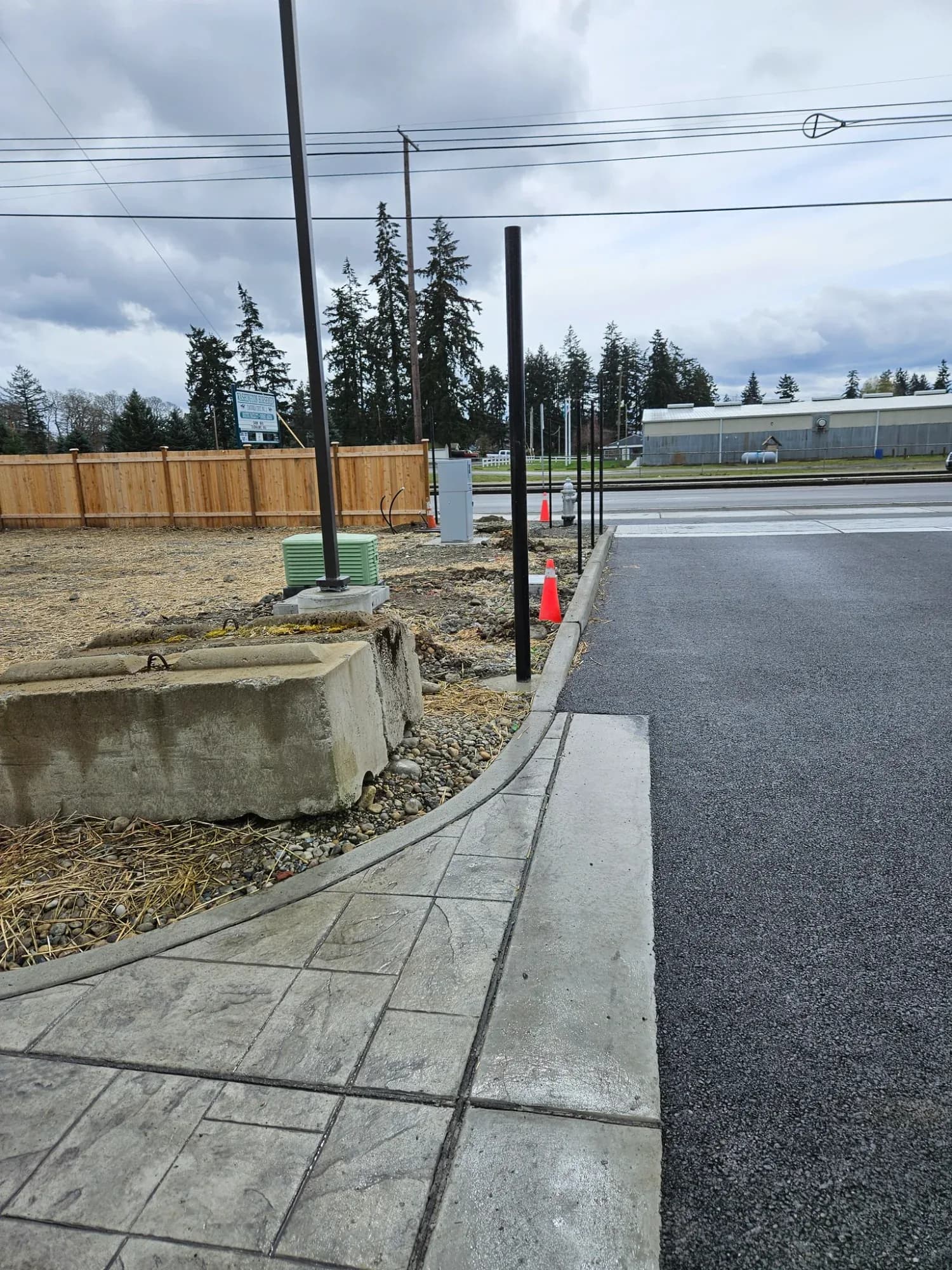
Construction & Infrastructure
Concrete foundations, site preparation, and infrastructure supporting fence and gate installations.
Fence and gate systems require proper foundations and site preparation to perform long-term. We handle the civil and concrete work that supports durable installations.
What We Do
- Concrete foundations for gate operators
- Post footings for fence systems
- Site grading and preparation
- Retaining walls adjacent to fence lines
- Trench work for electrical and drainage
- Bollard and barrier foundations
Best Fit For
- New fence and gate installations requiring foundations
- Sites with challenging soil or grade conditions
- Industrial projects with heavy-duty requirements
- Properties requiring integrated hardscape work
- Retrofits requiring new foundations
How We Deliver
- Site assessment and soil evaluation
- Foundation design for load requirements
- Excavation and forming
- Concrete placement and finishing
- Curing and protection
- Coordination with fence/gate installation
Standards & Compliance
- Local building codes for foundations
- Structural engineering when required
- Soil bearing capacity requirements
- ADA grade requirements where applicable
The Hidden Work That Matters
Most of what we build in construction is underground or invisible once complete. Foundations disappear beneath concrete pads. Trenches fill in. Grading blends into the landscape. The work is not glamorous, but it determines whether the visible elements,gates, fences, operators,perform reliably for years or develop problems.
Cutting corners on foundations and site work saves money initially but costs more over time. Posts shift in inadequate footings. Gates sag when track foundations move. Electrical runs fail when conduit is damaged by improper backfill. The visible installation cannot compensate for invisible defects beneath it.
We approach construction work with the understanding that we are building the platform for everything else. The gates and fences get the attention, but the foundations and infrastructure make them work.
Understanding Soil Conditions
Soil varies dramatically across Washington State. Western Washington has glacial till and wet coastal soils. Eastern Washington features volcanic ash soils and caliche hardpan. Rocky sites need different approaches than sandy or clay soils. Understanding local soil conditions guides foundation design.
We assess soil conditions during site evaluation. Sometimes visual inspection and local knowledge suffice. Sometimes we need geotechnical input for challenging sites. Foundation design that ignores soil conditions fails; design that accounts for actual conditions succeeds.
Drainage relates directly to soil. Wet soils around foundations cause frost heave, erosion, and long-term movement. Foundation design must account for water management. Proper grading, drainage paths, and sometimes French drains protect foundation performance.
Foundation Design Principles
Foundations transfer loads from above to the ground below. Gate posts carry gate weight and wind loads. Operator pads support equipment and resist reaction forces. Track beams support slide gates and guide their travel. Each application has different load characteristics requiring different foundation approaches.
Size matters, but so does reinforcement and anchor design. A large foundation with inadequate reinforcement cracks. A well-reinforced foundation with poor anchor embedment allows equipment to pull loose. Foundation design considers all failure modes, not just bearing capacity.
Frost depth affects foundation design in our climate. Foundations that do not extend below frost line can heave when soil freezes. The Puget Sound area has relatively mild frost conditions, but foundations still need adequate depth. Mountain and foothill areas require deeper foundations.
- Load analysis for actual forces
- Soil bearing capacity consideration
- Proper depth for frost protection
- Reinforcement for structural loads
- Anchor design for equipment attachment
- Drainage and water management
Concrete Quality and Placement
Concrete quality affects long-term foundation performance. Proper mix design, correct water-cement ratio, and adequate strength all matter. We specify concrete appropriate for the application,higher strength for structural foundations, air entrainment for freeze-thaw exposure, appropriate slump for placement conditions.
Placement technique affects quality. Concrete must be consolidated to eliminate voids. Forms must resist pressure without distortion. Cold weather and hot weather both require adjusted procedures. We place concrete correctly for conditions, not just conveniently.
Curing determines ultimate concrete strength. Concrete that dries too quickly never reaches design strength. Proper curing,keeping concrete moist and at appropriate temperature,allows full strength development. We protect fresh concrete and allow adequate cure time before loading.
Site Preparation
Fence and gate installation often requires site work beyond just the fence line. Grading establishes proper drainage away from gates and foundations. Clearing removes obstacles and vegetation. Grubbing removes roots that would interfere with post installation or cause future problems.
Access and staging affect project execution. Materials and equipment need routes to reach work areas. Staging areas store materials during installation. We coordinate site preparation with property operations to minimize disruption while maintaining efficient work flow.
Existing utilities require attention before excavation. Underground power, gas, water, telecommunications, and drainage may cross work areas. Utility locates identify known lines. Careful excavation protects against unknown lines. Damage to utilities is expensive, disruptive, and sometimes dangerous.
Trenching and Underground Work
Gate automation requires underground conduit from power source to gate location. Loop detectors need sawcuts in pavement. Drainage may need trenching along fence lines. Underground work follows the visible installation but must be completed before final grading and paving.
Trench work involves excavation, conduit installation, and backfill. Each step affects the next. Trenches must be properly sized and graded. Conduit must be protected and routed correctly. Backfill must be compacted to prevent settlement. Surface restoration must match surrounding conditions.
We coordinate underground work with electrical contractors, paving contractors, and other trades. Our trenching provides the pathways; others may install the wire. Clear understanding of scope and responsibilities prevents conflicts and ensures complete systems.
Demolition and Removal
New installations often require removing old ones. Fence replacement projects need demolition before construction. Gate upgrades may require foundation removal. Site redevelopment clears existing infrastructure for new construction.
Demolition requires planning. What is being removed? What must be protected? Where does the material go? Are there utilities to disconnect? Thoughtful demolition prepares the site efficiently. Careless demolition damages things that should be preserved and creates unnecessary waste.
We handle demolition as part of complete project scope. Removing the old and installing the new under one contract simplifies coordination and ensures the transition happens smoothly. The site goes from old system to new system without gaps in security or function.
Integration with Other Trades
Construction work interfaces with other trades. Electricians connect power to our conduit runs. Landscapers work around our fence lines. Paving contractors restore surfaces we trenched. General contractors coordinate our work with overall project schedules.
Clear scope definition prevents conflicts. Where does our work end and the next trade begin? Who is responsible for what? Written scope and regular communication keep projects moving without finger-pointing when things do not align.
We work well with other contractors. Years of commercial project experience have taught us how to coordinate effectively. We show up when scheduled, complete our scope as agreed, and communicate when conditions require adjustment. Professional performance makes us a preferred subcontractor.
Frequently Asked Questions
Do gate foundations require permits?
It depends on the jurisdiction and scope. Many simple operator pad foundations do not require permits. Large foundations, retaining walls, and work affecting drainage or utilities may require permits. We determine permit requirements during project planning and handle applications when required.
How long must concrete cure before installing gates?
Concrete reaches approximately 70% of design strength in 7 days under normal conditions. For typical gate installations, we wait at least 7 days before mounting operators or hanging heavy gates. Critical structural applications may require longer cure times. We schedule foundation work with adequate lead time before equipment installation.
Can you work in winter weather?
Yes, with appropriate precautions. Concrete can be placed in cold weather using heated materials, insulated forms, and curing blankets. Excavation in wet conditions may require dewatering. We adjust methods for seasonal conditions rather than shutting down, though some work may be more practical in better weather.
What if you encounter rock during excavation?
Rock is common in parts of our service area. Light rock can be broken with excavator-mounted hammers. Heavy rock may require drilling or specialized equipment. We assess likely conditions during estimation but cannot always predict what is underground. Rock encountered during construction is addressed as needed, with cost implications discussed before proceeding.
Do you handle erosion control and site stabilization?
For work directly related to fence and gate projects, yes. We manage erosion on our work areas and restore sites to stable condition. Large-scale erosion control, environmental permitting, and stormwater management beyond our immediate work area are typically handled by others or as separate scope.
Construction & Infrastructure Services
Explore specific services within this division.
Concrete Foundations for Gates & Fences
Engineered concrete foundations for gate operators, support posts, slide gate tracks, and structural fence systems,designed for actual loads and soil conditions.
Learn moreSite Prep & Civil Support
Grading, excavation, drainage management, and site preparation ensuring fence and gate systems install correctly and perform long-term.
Learn moreRetaining & Hardscape Adjacent Work
Retaining walls, masonry columns, and hardscape elements that integrate with fence and gate systems,managing grade changes while creating cohesive perimeter solutions.
Learn moreCommercial Site Systems
Bollards, vehicle barriers, guard booth foundations, pedestrian control infrastructure, and site elements supporting comprehensive commercial security systems.
Learn moreTrenching & Underground Utilities
Underground conduit, trenching, and utility work supporting gate automation systems.
Learn moreDemolition & Removal
Removal of existing fence, gate, and concrete infrastructure prior to new installation.
Learn moreReady to Get Started?
Request a quote for your commercial, industrial, or residential project.